
FAQs
how etheco works


about etheco
How is etheco different from other sites?
etheco is built differently. Most comparison and switching sites maximise their earnings by steering you toward providers that pay the highest commission and often exclude those that don’t pay commissions. Their rankings can be distorted by commercial relationships, not quality or ethics. Many also hide their methodology entirely.
etheco is different in three important ways. First, our ratings methodology is honest, transparent and never influenced by any partner relationship we may have to help us fund our activities. Second, our content (including guides, reviews, news and views) is completely independent and not impacted whatsoever by any partnership we may have. Third, we measure the real social and environmental impact of every switch, not just the price.
We’re also building guided switching flows directly into the platform, so you can act on what you learn without having to navigate away to another site.
Is etheco free to use?
Yes. etheco is completely free for consumers. Browsing, ratings, guides and switching tools are all available without charge. We cover our costs through partnerships (which are always clearly labelled and never influence our ratings or editorial content) with businesses that share our values and through helping businesses to become more ethical and eco-friendly in everything they do.
Who is behind etheco?
etheco was founded by Jason Hollingsworth and is led by a small, hand-picked team of professionals who share a genuine commitment to making ethical and eco-friendly consumer choices simple. The founding team brings decades of combined experience across finance, journalism, creative direction, technology and sustainability. You can read much more about each of us on the Our Team page.
How does etheco ensure it remains independent and practises what it advocates?
Trust is the foundation of everything we do, and independence is at the heart of our ethos. Any partnership or relationship we have or develop will never influence how we evaluate goods and services.
We always practice what we advocate by holding ourselves to the same standards we hold others to. Every penny we spend and every relationship we develop is assessed against the same 4Ps framework we use to rate the businesses.
At etheco, we bank with Triodos and Nationwide (formally Virgin Money), both widely regarded as being in the top tier in UK ethical banking. Our insurance is with Naturesave, the UK’s leading ethical insurer. Our website runs on Green Hosting, powered by 100% renewable energy. We’re also a member of 1% for the Planet – committing at least one per cent of our annual revenue to environmental causes, and we are looking to put Nature on our Board (link to specific FAQ).
Every member of the etheco team has completed a personal ethical assessment covering their banking, insurance, energy, pension, diet and lifestyle choices. We are all striving to make better choices wherever we can.
Where we can’t yet meet the highest standard we aspire to, we say so openly. We believe transparency about where you’re falling short is just as important as celebrating where you’re getting it right.
etheco ratings
What is the etheco cosmos?
The etheco cosmos is how we display ratings visually. The central etheco score sits at the heart, with orbiting planets representing each of the 4Ps. The etheco score represents a weighted average of each of the four pillars.
At a glance, you can see not just the overall rating but where a company’s strengths and weaknesses lie.
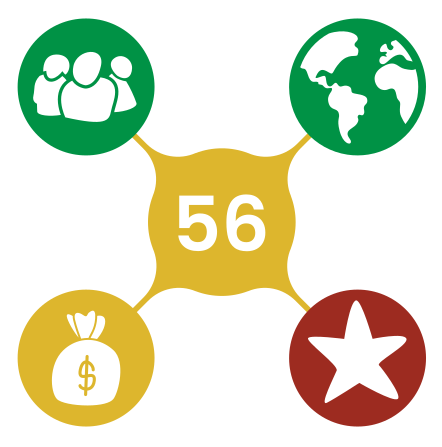
The etheco score and each pillar is colour-coded: green for good, amber for average, red for poor. Listings in the directory are ranked by etheco score, highest first, lowest last.
Coming soon – in the near future, you’ll also be able to adjust the weighting of the four pillars to reflect your own priorities. If Planet matters more to you than Pocket, drag the Planet orbit outward and the rankings will reorder to match your values. Your adjusted cosmos becomes your personal lens on the etheco directory, based on what matters most to you.
What are the 4Ps and why are they weighted the way they are?
| Pillar | What we assess | Weight |
|---|---|---|
| People | Workers’ rights and fair pay, community investment, governance and transparency, diversity and inclusion and supply chain ethics. | 35% |
| Planet | Carbon and climate commitments, environmental certifications, waste reduction and circular design, biodiversity and the product’s lifespan. | 35% |
| Affordability, pricing transparency, total cost of ownership, warranty, ongoing charges and whether the ethical option is genuinely accessible. | 15% | |
| Performance | Customer satisfaction, complaints process, industry awards, terms and conditions fairness and product or service claims. | 15% |
People and Planet together carry 70% of the score, so a company can’t achieve a high etheco rating on consumer appeal alone. But being ethical isn’t enough either – companies also need to deliver genuine value and quality. That’s where Pocket and Performance come in.
Pocket is a key differentiator for etheco. Most rating platforms don’t factor in pricing or consumer value at all. We think that’s a mistake. If ethical living is only accessible to people with premium budgets, it will never go mainstream.
Businesses that meet our minimum threshold can progress towards Verified by etheco status (coming soon).
How is the etheco score calculated?
The overall etheco score is a weighted average of the four pillar scores:
(People × 0.35) + (Planet × 0.35) + (Pocket × 0.15) + (Performance × 0.15)
As per the table above, within each pillar, businesses are assessed against a set of specific criteria. People, Planet and Pocket each have five criteria (scored 0–20); Performance has four (scored 0–25). For example, the People pillar looks individually at workers’ rights, community impact, governance, diversity, and ethical supply chain – rather than relying on a single headline number.
Bonus points are awarded for key accreditations such as B Corp certification, and penalties are applied for regulatory breaches, fines or legal action. Some accreditations – like B Corp scores – feed into more than one pillar, because their assessments span social, environmental and consumer dimensions.
Where does the data behind the etheco score come from and how is it prioritised?
The quality of an etheco rating depends entirely on the quality of the data behind it. We draw on five tiers, ranked by reliability and independence – the higher the tier, the more weight it carries in our algorithm:
- Tier 1 – Regulatory and open data. Publicly available data from regulators and government bodies – for example, FCA complaint data, Ofgem performance data, and gender pay gap filings. This is our most reliable layer: standardised, comparable, and difficult to game.
- Tier 2 – Independent accreditations. Certifications from recognised bodies such as B Lab, Fairtrade, the Soil Association and the Living Wage Foundation. These are highly credible binary signals, with a company either holding them or not.
- Tier 3 – Third-party ratings. Assessments from organisations such as Ethical Consumer and the Good Shopping Guide. Independently researched with robust methodologies.
- Tier 4 – Consumer sentiment. Customer reviews, complaint volumes and satisfaction data from platforms including Trustpilot and Google Reviews. These are directional indicators, using review volume as a signal of confidence.
- Tier 5 – Self-reported data. Information published by the companies themselves, such as annual reports and sustainability disclosures. Useful for filling gaps but carries the lowest weighting – no company can score highly on the strength of its own marketing alone.
We currently source and use publicly available data. We’re also developing data partnerships to enable more granular scoring over time.
How often are ratings updated?
A: It depends on the data. Some sources – like consumer trust scores – will be updated more regularly than say data published quarterly, which will be updated soon after release. As a minimum, every component of our ratings is reviewed at least once a year. As our proprietary etheco ‘brain’ is enhanced, our aim is to utilise as much real-time information as possible.
Where a material event occurs — such as a company losing its B Corp status, a regulatory enforcement action, or a change of ownership — we may trigger an earlier review. The aim is for ratings to reflect both a company’s long-term track record and any significant recent developments.
[INFO GRAPHIC HERE]