

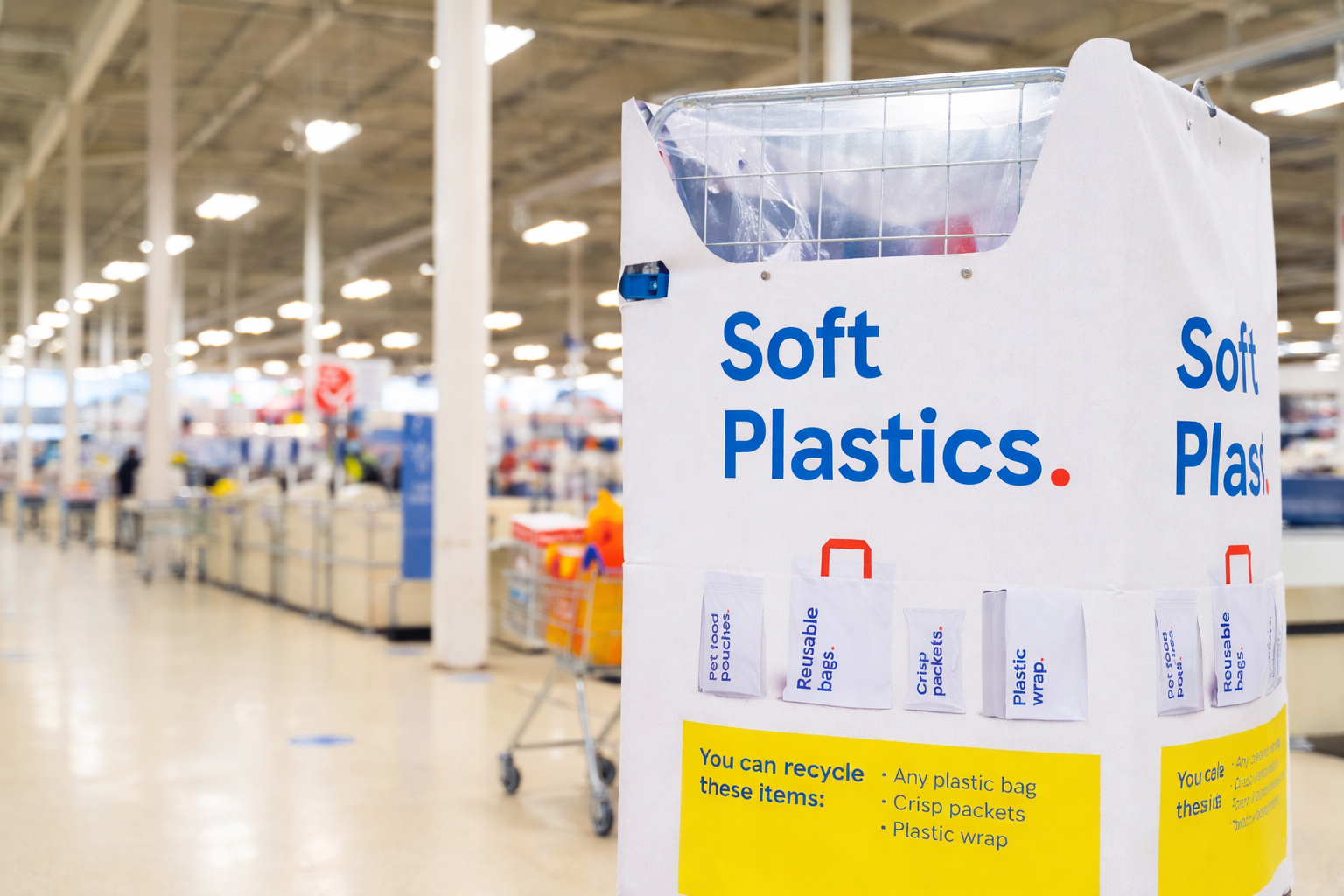
Soft plastic recycling at UK supermarkets is easier than many people realise. Here’s what you can recycle, where to take it and why it matters
Soft plastic recycling at UK supermarkets is becoming one of the easiest ways to deal with packaging that cannot go in your household recycling bin. Bread bags, crisp packets and salad wrappers are still excluded from most kerbside collections, but many supermarkets now offer front-of-store drop-off points.
According to WRAP (2025), soft plastics make up almost a quarter of UK consumer packaging by weight, yet only a small proportion is currently recycled. Until kerbside film collections become mandatory in England in March 2027, supermarket schemes are one of the most practical ways to keep this material out of landfill and incineration.
What counts as soft plastic?
Soft plastics are flexible, scrunchable materials that do not hold their shape. If you can squeeze it in your hand and it stays scrunched, it is usually a soft plastic.
Common examples include:
- Bread bags and bakery wrappers
- Fruit and vegetable bags
- Crisp packets and sweet wrappers
- Pasta, rice and cereal inner bags
- Frozen food bags
- Toilet roll and kitchen roll outer wrap
- Bubble wrap and magazine wrappers
- Carrier bags and worn-out bags for life
Most councils do not currently collect these materials at the kerbside. If they are placed in your household recycling bin, they may be removed as contamination or cause problems at the recycling plant.
Which soft plastics cannot be recycled?
Supermarket collection points are only designed for flexible plastic packaging. The following items should be kept out:
- Hard plastics such as yoghurt pots and ready meal trays
- Polystyrene or foam packaging
- Compostable or biodegradable plastics
- Food-contaminated cling film
- Plastic-coated paper such as takeaway coffee cups
- PVC packaging, including medicine blister packs
A useful rule of thumb is that if the packaging is rigid, foamy or has food left on it, it probably does not belong in the soft plastic bin.
What labels to look for on packaging
The easiest way to check whether something can be returned to a supermarket is to look for the On-Pack Recycling Label (OPRL).
The most useful label is:
- ‘Recycle with bags at large supermarkets – Don’t recycle at home’
You will often see this on bread bags, fruit and veg bags, frozen food packaging and crisp packets. It means the item can be recycled through a supermarket collection point.
You may also see labels that say:
- ‘Recycle’ – suitable for your household recycling bin
- ‘Don’t recycle’ – not currently accepted through mainstream recycling schemes
The small numbered triangle found on some packaging shows the type of plastic used, but it does not tell you whether the item can actually be recycled. In practice, the OPRL label is more helpful.
Which UK supermarkets recycle soft plastics?
Most major supermarkets now offer some form of soft plastic recycling, although availability can vary between stores.
- Tesco: collection points in all large stores and many Tesco Express branches
- Sainsbury’s: soft plastic bins available in all supermarkets
- Co-op: collection points in larger stores for own-brand and other packaging
- Waitrose: around 295 stores offer soft plastic recycling
- Morrisons: front-of-store bins for plastic bags, films and wrappers
Aldi, Lidl, Asda and Iceland do not yet have nationwide schemes, although some branches may offer local collection points. The Recycle Now locator can help you find the nearest option.
Before returning packaging, it helps to make sure it is:
- Empty and dry
- Free from food residue
- Loose rather than tied tightly in a bag
These small steps make the recycling process much more effective.
What happens after you drop it off?
Once collected, soft plastics are sent to a sorting and reprocessing facility. The material is cleaned, separated by plastic type and turned into flakes or pellets.
These recycled materials can then be used to make:
- Bin liners and refuse sacks
- New plastic bags
- Outdoor furniture and fencing
- Building materials such as damp-proof membranes
The system is still developing. Research by the Environmental Investigation Agency and Everyday Plastic (2024) found that some soft plastic collected by supermarkets is still burned for energy or exported because UK recycling capacity remains limited. Even so, many people see supermarket recycling as a useful stepping stone. It helps reduce contamination in household recycling bins and shows retailers that there is demand for better recycling systems.
How soft plastic recycling scores on the etheco 4Ps
At etheco, we look at decisions through the lens of people, planet, pocket and performance.
- People: recycling soft plastics closer to home may reduce the amount of waste that is exported or burned.
- Planet: every bag or wrapper recycled can help reduce demand for new plastic made from fossil fuels.
- Pocket: supermarket schemes are free and easy to use alongside your regular shop.
- Performance: the system is not perfect yet, but it works best when packaging is clean, dry and correctly sorted.
Soft plastic recycling is not a complete answer to the UK’s packaging problem. Reducing unnecessary packaging and choosing reusable options where possible still has the biggest impact. For now, though, taking your bread bags and crisp packets back to the supermarket is one small step that can make a meaningful difference.
References
WRAP / Recycle Now (2025), Repeat the Cycle campaign materials.
On-Pack Recycling Label (OPRL) (2024), Specialist recycling labels and guidance for consumers.
Environmental Investigation Agency and Everyday Plastic (2024), The Hard Truth About Soft Plastic.
RECOUP (2025), UK Household Plastic Packaging Collection Survey.
Department for Environment, Food and Rural Affairs (Defra) (2024), Simpler Recycling in England: policy update.
Tesco (2024), Soft plastic recycling scheme update.
John Lewis Partnership (2023), UK-based soft-plastic recycling available at Waitrose.