

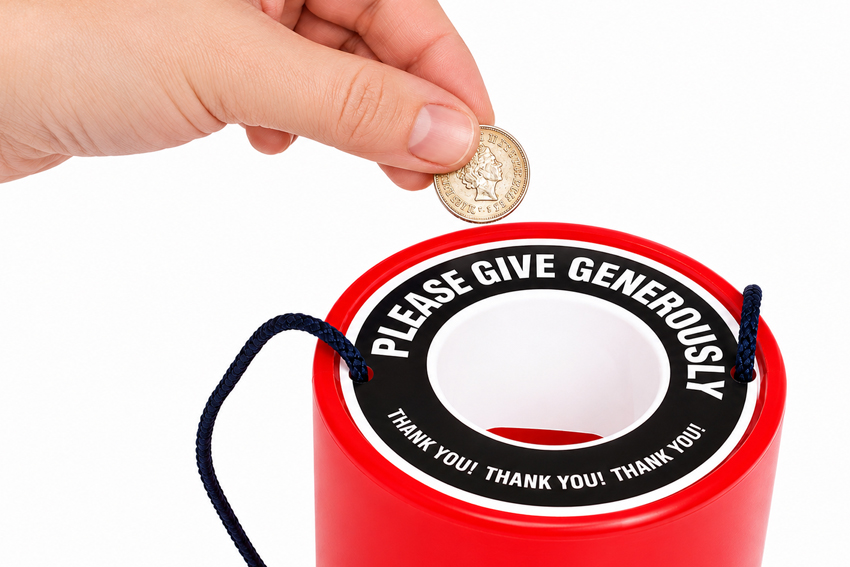
Most of us give from the heart – but how much of your donation actually reaches the cause? This guide looks at where the money goes, and how to give so that more of it counts
Generosity is one of our better instincts. UK donors give billions every year, often without a second thought about how that money travels from their bank account to the cause it is meant to help. Yet those mechanics matter: the route you choose, the platform you use and the way you sign up all affect how much of your gift the cause ever sees. Giving wisely is not about giving less – it is about making your money work as hard as you do.
The trouble with ‘chuggers’
You will know them from the high street: the brightly bibbed fundraisers who step into your path with a clipboard and a smile. ‘Chuggers’ – a blend of ‘charity’ and ‘mugger’ – is the nickname for face-to-face (‘F2F’) street fundraisers, a significant source of income because it secures long-term, regular donors.
Here is what many donors do not realise. These fundraisers are rarely volunteers – they are usually employed by a private, for-profit agency the charity pays a commission for every new direct debit, often £40 to £60 per sign-up. When a supporter starts at £5 a month, it can take eight to 12 months before the charity sees a penny – the early months cover the cost of recruiting you.
None of this makes street fundraising a scam – over the years a loyal donor generates a healthy return. But donors deserve transparency. Since 2008, paid fundraisers must disclose that they are paid and that an agency is involved. If approached, it is fair to ask how much of your first year goes to the agency – and whether giving directly would get more to the cause.
The most cost-effective way to give
If you want the maximum to reach the cause, the simplest route is usually best: a direct debit or standing order set up with the charity itself. This avoids agency commissions and platform fees, gives the charity predictable income, and lets it claim Gift Aid easily.
Online fundraising platforms have their place, especially for sponsored events, but they are not all equal – or all non-profit. Most advertise ‘0 per cent platform fees’, yet processing charges of around 1.9 per cent plus 20p to 30p per donation still apply, and some take a cut of your Gift Aid or nudge donors towards an optional ‘tip’. It’s worth knowing that JustGiving is a commercial fundraising platform, while GoFundMe and CAF Donate often offer lower-cost fundraising options.
Don’t forget Gift Aid
If you are a UK taxpayer, Gift Aid is the easiest way to boost your donation at no cost to you. For every £1 you give, the charity can reclaim 25p from HMRC – turning a £100 gift into £125 – because you have already paid tax on that money. All it takes is a short declaration.
Higher- and additional-rate taxpayers can also reclaim the difference between their rate and the basic rate through self-assessment. And as Gift Aid is funded through taxation – around £1.7 billion of public money each year – there is an even stronger case for directing donations to the most effective causes.
Impact, outcomes and ‘theory of change’
How much of your donation reaches the cause is only half the story; the other half is what the charity achieves with it. A well-run organisation should be able to explain its theory of change – the chain linking what it does to the difference it makes. Major funders now expect to see one, and it is a good test for donors: can the charity tell you not just what it spends, but what changes as a result?
Beware the ‘overhead myth’, though. Judging a charity purely on its admin percentage is misleading: one spending almost nothing may be starving itself of the staff and systems that make its work effective. The better question is ‘how much impact is created per pound – and can the charity prove it?’
Accreditations that build confidence
You don’t have to take a charity’s word for it. Several independent quality marks signal an organisation is well-governed and accountable:
- Trusted Standard (formerly PQASSO) – the NCVO’s quality mark, covering 11 areas including governance and finance.
- Improving Quality (IQ) – built around effective management and governance for not-for-profits.
- Investors in Diversity for Small Charities – an equality, diversity and inclusion framework from the National Centre for Diversity.
- Chartered Institute of Fundraising – membership signals transparent, ethical fundraising.
- Fundraising Regulator – look for its tick logo, showing a commitment to the Code of Fundraising Practice.
Who holds charities to account?
Charities are not unregulated. In England and Wales the Charity Commission oversees how charities are run, while the Fundraising Regulator enforces the Code of Fundraising Practice (Scotland has its own panel), updated from 1 November 2025.
And yes, the Advertising Standards Authority (ASA) gets involved. Charity adverts must not misrepresent the cause, exaggerate its scale, or be unclear about where donations end up, and the ASA has upheld complaints on these grounds. Its codes do not cover everything, though: live, in-person and telephone fundraising fall outside them, governed instead by consumer-protection law – a gap that arguably deserves closer attention as giving moves online.
How giving wisely scores on the etheco 4Ps
At etheco, we judge decisions through the lens of Planet, People, Pocket and Performance – and charitable giving fits neatly:
- Pocket: how much really reaches the cause? Giving directly, claiming Gift Aid and choosing a low-cost platform all stretch every pound further.
- Performance: does the charity deliver value for money – measurable impact per pound – and show a clear theory of change?
- People: well-run charities treat donors, beneficiaries and staff fairly and transparently.
- Planet: for environmental causes, is the money creating real, lasting change for nature?
Should charities be held to account against standards like these? We think so – giving is an act of trust, and trust is strengthened by transparency. Take a look at our etheco directory to explore ethical organisations and causes that we highly rate.
References
https://www.ncvo.org.uk/help-and-guidance/strategy-and-impact/impact-evaluation/theory-of-change/Advertising Standards Authority (CAP), Third sector, charity and public awareness advertising
Charities Aid Foundation (2025), UK Giving Report 2025
Fundraising Regulator (2025), Code of Fundraising Practice (effective 1 November 2025)
GoFundMe (2025–26), Platform and processing fees
JustGiving (2025–26), Platform and processing fees
HM Revenue & Customs, Chapter 3: Gift Aid – detailed guidance notes
House of Commons Library (2025), ‘Chuggers’: face-to-face charity fundraising on the street (SN06027)
NCVO, Theory of Change guidance
NPC, Impact measurement guidance
Plinth (2026), The overhead ratio myth: does ‘how much goes to the cause’ actually matter?
Wikipedia, Street fundraising (accessed June 2026)
Wikipedia, Gift Aid (accessed June 2026)